

Insights into the Mechanism of Anionic Polymerization of a Bio-Derived Monomer
Due to the negative environmental impact of today’s mass production of plastics, modern polymer chemistry is seeking more sustainable alternatives. As an approach that counteracts the exploitation of fossil raw materials, bio-based monomers are being used as substitutes for traditional monomers derived from fossil raw materials.
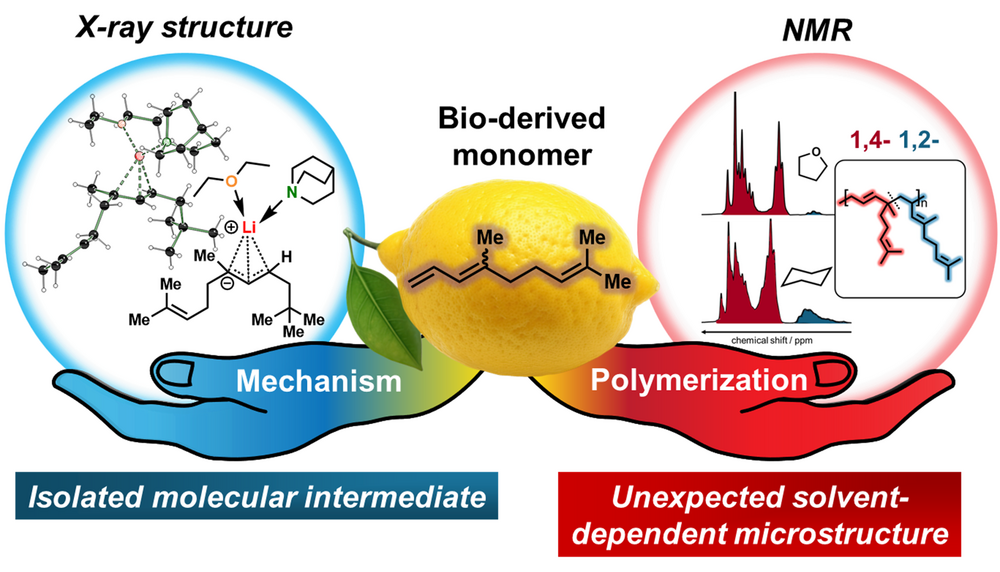
Within this context, our publication focuses on the new bio-derived monomer DMNT (4,8-dimethyl-1,3,7-nonatriene), which can be produced from citral via a Wittig olefination reaction. Through renowned and leading partners in the field at Johannes Gutenberg University Mainz (group of Prof. Dr. Holger Frey and Prof. Dr. Axel Müller), the monomer DMNT was successfully anionically polymerized; however, it was noted that, contrary to expectations, a higher proportion of the 1,4 microstructure was obtained in the presence of the polar solvent THF. For classical monomers such as isoprene and butadiene, a lower proportion of the 1,4 microstructure is always obtained in more polar solvents.
By varying the organometallic reaction conditions, it was possible to stop the polymerization after the first carbolithation step and subsequently isolate the reactive organometallic intermediate of the polymerization after crystallization. A pronounced delocalization of the negative charge into the allyl unit was observed. Subsequent characterization in solution using NMR spectroscopy confirmed the structure in solution as well, but also revealed the presence of a different aggregate in the solvent THF. In this case, the lithium center is presumably coordinated by three ligands instead of two.
Quantum chemical DFT calculations based on this ultimately explained the occurrence of the solvent-dependent microstructure. Thus, the number of ligands, the polarity of the solvent, and the 4,4-substitution pattern of the DMNT all play a role in stabilizing the relevant transition states, which ultimately lead to the formation of the observed 1,4-microstructure.
Through this interdisciplinary study, it was thus possible not only to introduce a new monomer but also to elucidate and understand the mechanism of its anionic polymerization.