

Dimethyl ether for Lithiumorganics
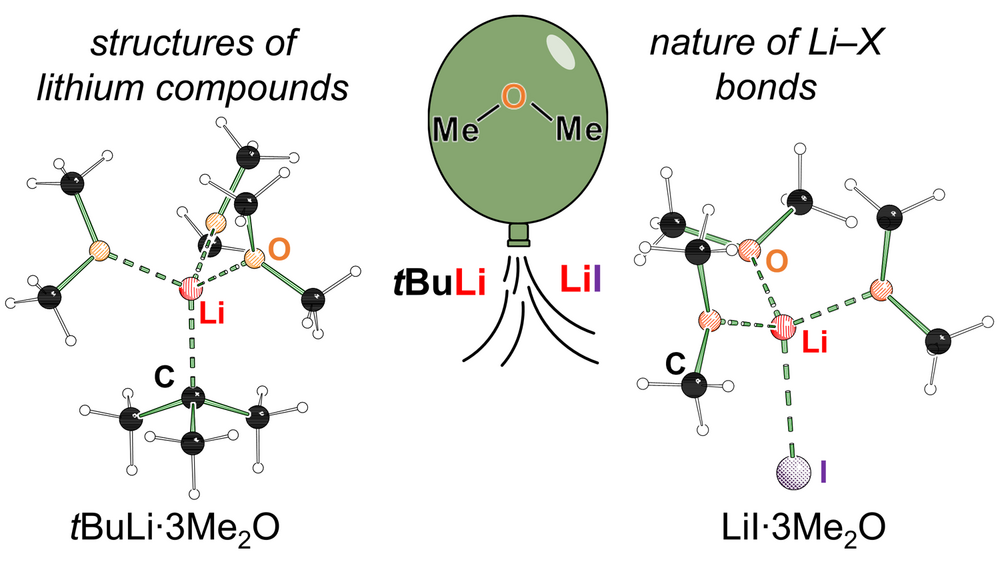
Dimethyl ether is the smallest possible ether. Due to its low boiling point (–24.8 °C), this ether has rarely been used in synthetic applications or as a ligand for organometallic compounds. Instead, it is a commonly used model ligand in quantum chemical calculations to save computation time or to limit the degrees of freedom of other ethers.
In our publication, we have now been able to present structures of typical, commercially available organolithium compounds with dimethyl ether. The solid-state structures of methyl lithium, tert-butyl lithium, phenyl lithium, and trimethylsilylmethyl lithium thus represent prototypical compounds serving as an experimental basis for compounds that are otherwise only approximated theoretically. In particular, it is striking that the aggregates obtained closely resemble those with THF, but not those with diethyl ether. It should therefore first be considered for each system whether dimethyl ether may be used to simplify quantum chemical calculations.
The crystals obtained are of high quality, which allowed for the acquisition of high-quality solid-state structures. In particular, a high-resolution solid-state structure of monomeric tert-butyllithium with three coordinating dimethyl ether ligands was obtained, enabling electron density analysis, which was carried out by experienced collaborators at Georg-August University of Göttingen (Prof. Dr. Dietmar Stalke and Dr. Regine Herbst-Irmer). Furthermore, a similar high-resolution structure of the monomeric lithium iodide with three coordinating dimethyl ether ligands was obtained, making it possible for the first time to perform a comparative electron density analysis of a lithium alkyl and a lithium halide. It was found that the Li–C bond in monomeric tert-butyllithium is strongly polar, but does not yet match the even more polar Li–I bond.
Furthermore, it was observed that the Li–O distances between the lithium center and the dimethyl ether ligands respond to this different bonding situation. This results in a shortening of the Li–O bonds in lithium iodide to compensate for the missing electron density of the Li–I bond at the lithium center.
With our study, we introduce dimethyl ethers into the field of organometallic chemistry as a new, rigid, and promising ligand for obtaining high-quality solid-state structures.