

Recent publication in Inorganic Chemistry
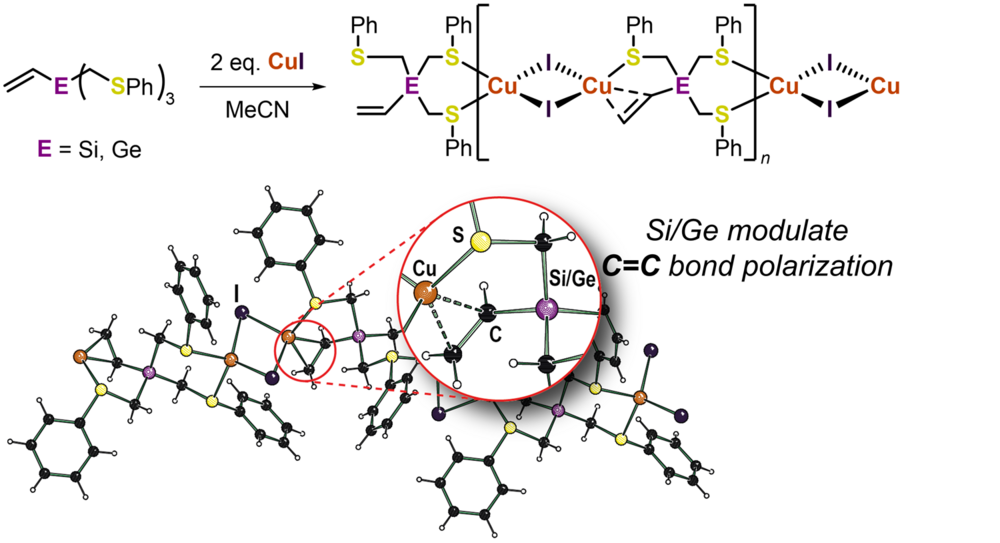
Vinyl–Cu(I) π-complexes are unusual bonding motifs, whose targeted preparation has so far been achieved only in a few exceptional cases. The aim of this work was therefore to experimentally investigate the prerequisites for the selective activation of vinyl groups toward π-coordination.
The employed vinyl tris(thioether) ligands CH₂=CH–E(CH₂SPh)₃ (E = Si, Ge) feature a silicon- or germanium-substituted vinyl group, which polarizes the C=C bond toward the α-carbon atom and, in combination with a soft donor environment, enables the formation of one-dimensional Cu(I) coordination polymers, whereas the purely carbon-based analogue (E = C) shows no complex formation under comparable conditions. In the resulting systems, the vinyl group occupies one coordination site at the copper center in a side-on π‑binding geometry, while Cu(μ₂‑I)₂Cu rhomboids constitute the backbone of the polymer chains.
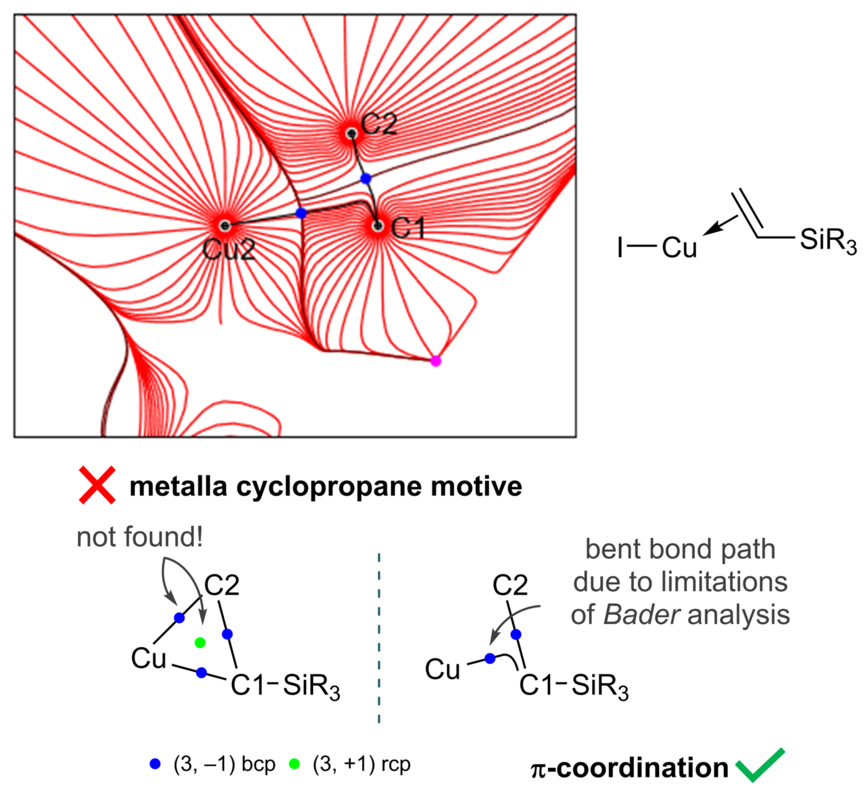
For the silicon-based system, high-resolution single-crystal X-ray diffraction data were obtained and evaluated by multipole refinement, allowing the vinyl–Cu(I) π-interaction to be visualized directly in the experimental electron density for the first time. Comparative studies of the isostructural germanium polymer indicate weaker π‑bonding but reveal an unusual, reversible temperature-dependent site-exchange process of the germanium atom, accompanied by inversion of the thioether arms. These findings underscore the central role of main-group element polarization as a key tool for controlling π-coordination at copper(I).
Polarization Effects of the Heavier Group 14 Elements on Vinylic Carbon–Carbon Double Bonds: Enabling an Unusual π-Coordination of Copper(I) Iodide in Coordination Polymers
J. Wattenberg, T. Schrimpf, P. E. Schneider, P. E. Braun Streb, M. Knorr*, R. Wang, U. Englert* und C. Strohmann*
Inorg. Chem., accepted, 2026.